Press F5 to refresh page
What is Ataxia?
SCAA Inc ( Spino Cerebellar Ataxia Australia Inc ) www.scars.org.au was
formed because of the lack of information about Ataxia in Australia.
The hereditary and sporadic ataxias are a complex group of diseases and
so this information leaflet hopes to be a brief overview. This information
is not intended in any way to replace information you have received from
your doctor(s).
SCAA Mission Statement : To promote and
support Spinocerebellar Ataxia in all forms and to lead the quest for
knowledge, diagnosis, treatment and prevention of SCA with support from
communities worldwide.
Being diagnosed with Ataxia can be overwhelming. Below are a few frequently
asked questions that can help you to understand ataxia better.
What is Ataxia?
The word "ataxia", comes from the Greek word, " a taxis"
meaning "without order or in-coordination". The word ataxia
means without coordination. People with ataxia have problems with coordination
because parts of the nervous system that control movement and balance
are affected. Ataxia may affect the fingers, hands, arms, legs, body,
speech, and eye movements. The word ataxia is often used to describe a
symptom of in-coordination which can be associated with infections, injuries,
other diseases, or degenerative changes in the central nervous system.
Ataxia is also used to denote a group of specific degenerative diseases
of the nervous system called the hereditary and sporadic ataxias which
Spino cerebellar Ataxia Australia Inc. primarily emphases.
You are not alone
Australian statistics : There are increasing dozens of SCAs being found.
All dominant SCAs are at least 5/100,000 so in 22 million in Australia
= about 1100 of us.
How is Ataxia Diagnosed?
Diagnosis is based on a person's medical history, family history, and
a complete neurological evaluation including an MRI scan of the brain.
Various blood tests may be performed to rule out other possible disorders
which may present similar symptoms. Genetic blood tests to prevent previous
misdiagnoses are now available for some types of hereditary ataxia to
confirm a diagnosis or as a predictive test to determine if someone has
inherited an ataxia gene known to affect other family members.
Testing is difficult and personal. Support in making such decisions is
available from genetic counsellors
What are Common Symptoms?
Symptoms and time of onset very according to the type of ataxia. In fact
there are often variations even within the same family with the same type
of ataxia. Dominant ataxia often begins in the 20s or 30s or even later
in life. Sometimes individuals may not show symptoms until they are in
their 60s.
Typically balance and coordination are affected first. In coordination
of hands, arms, and legs, and slurring of speech are other common symptoms.
Walking becomes difficult and is characterized by walking with feet placed
further apart to compensate for poor balance. Impaired coordination of
the arms and hands affect a person's ability to perform tasks requiring
fine motor control such as writing and eating. Slow eye movements can
be seen in some form of ataxia. As time goes on, ataxia can affect speech
and swallowing. Extreme care must be taken with any anaesthetics or operations
because of poor swallowing ! TELL YOUR DOCTORS PLEASE !
All people with progressive neurological conditions are susceptible to
depressive illness, moods and other psychological conditions. Anti-depressants
and counselling may be helpful.
Tremor, stiffness, spasticity, sleep disorder, cold feet, sphincter
disturbance etc are other symptoms.
There are many more other symptoms - too many to mention !
What is Sporadic Ataxia?
There is a large group of people who have symptoms of ataxia that usually
begin in adulthood and who have no known family history of this disease.
This is called sporadic ataxia and it can be difficult to diagnose. There
are many acquired and hereditary causes of ataxia which must be ruled
out before a diagnosis of sporadic ataxia can be made.
Management of Symptoms
It is essential to have regular reviews for treating symptoms with a good
multidisciplinary team which may include a good GP + regular flu etc jabs,
who may co-ordinate Neurologists, Rehabilitation physicians, Speech Therapists,
Psychiatrists or Psychologists, Genetic Counsellors, Pastoral Care Workers,
Physiotherapists for critical exercise, even Personal Trainers, Occupational
Therapists for walking aids and home improvements, Dieticians, Sleep Specialists
and others.
The goal of treatment is to improve the Quality of Life through Education
and essential exercise whenever possible - even dancing, timely involvement
of other specialists and medical treatment of specific symptoms
Naturopathic, homeopathic and other natural remedies may prove useful
too with your Drs' knowledge.
Recreation
Have fun ! Do what you enjoy doing most ! and please help us to help you
and join www.scars.org.au and come along to a meeting and meet everyone
please ? We can offer companionship and information for people coping
with ataxia and the challenges involved too.
How do I Get More Information?
Please discuss specific questions concerning your situation with your
doctor (s). Also we encourage you to visit our website for additional
information on ataxia, online chat groups and more : www.scars.org.au
ABN No: 83 672 018 976 Deductible Gift Recipient status also held
Disclaimer : Information and articles contained
in this leaflet is intended to provide useful information of a general
nature for the reader but is not intended to be a substitute for legal
or medical advice.
We are not recommending legal or medical advice and readers
must seek their own legal and medical advice as may be appropriate
This leaflet was reviewed in Mar 2010 in
collaboration with Prof Storey ( pls advise initials etc and contact )
Also credits to NAF (National Ataxia Foundation) USA and Ataxia UK
+ membership form : http://www.scars.org.au/forms/memberapp.doc
Photos :
First SCA meeting on first page of website: http://www.scars.org.au/OnlineGallery/pages/SCA2007.html
Melissa and Jane wearing lanyards : first pic in photo gallery : http://www.scars.org.au/OnlineGallery/pages/2009MelissaJane.html
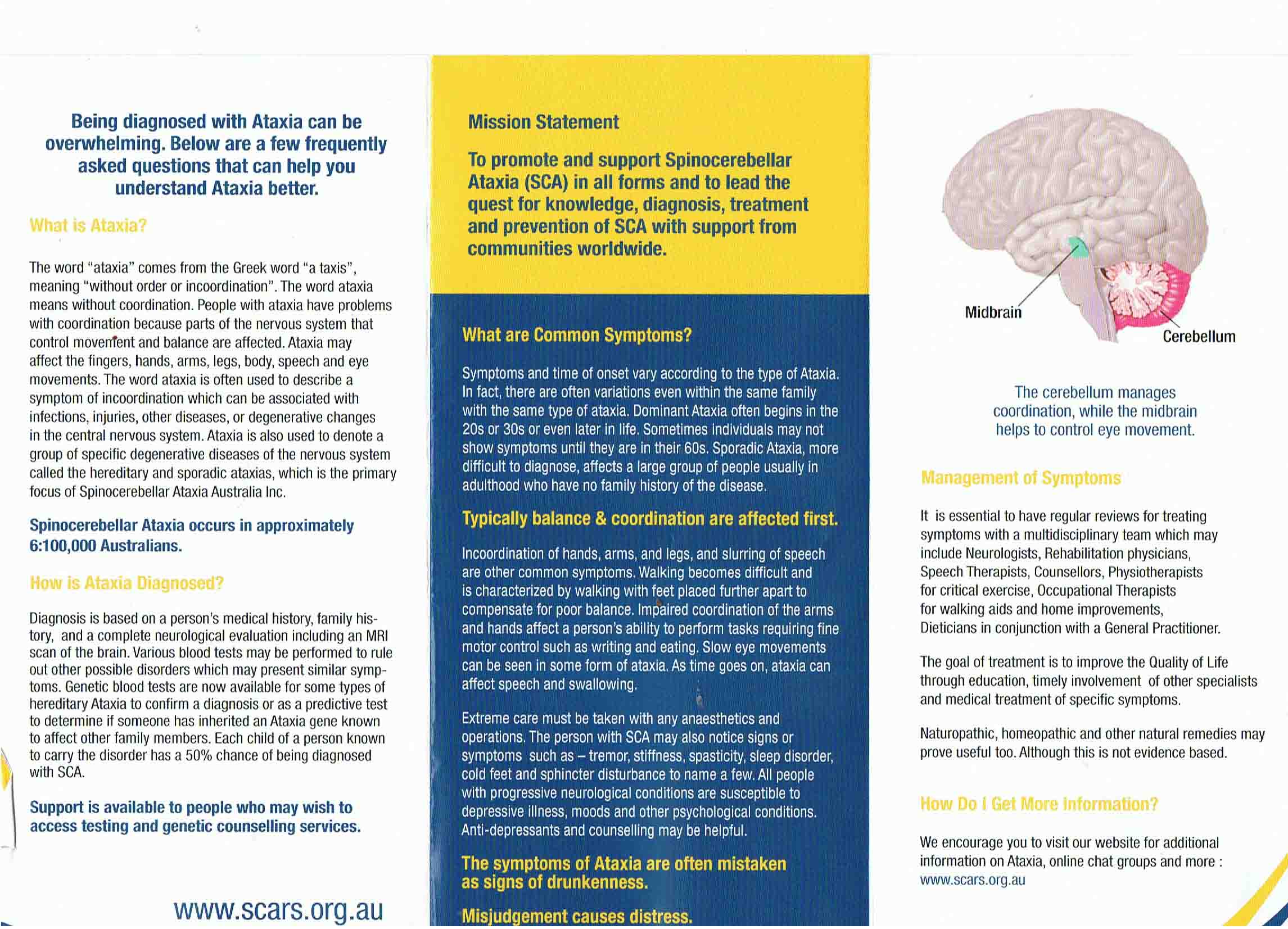
MRI ( brain image ) from Prof Storey
© Spinocerebellar Ataxia Australia Inc |